Working Principles and Core Technologies of Nitrogen Compressors
A nitrogen compressor is a specialized mechanical device designed to compress nitrogen gas and deliver it to end-use points. Its operation is grounded in fundamental principles of gas dynamics and thermodynamics. Although nitrogen is chemically inert, its compression process must still adhere to standard compression mechanics while ensuring gas purity and system integrity.
Common types include reciprocating (piston), screw, centrifugal, and scroll compressors. Reciprocating compressors suit low-flow, high-pressure applications (e.g., laboratories or small injection molding), achieving discharge pressures up to 30 MPa. Screw compressors, known for compact design and smooth operation, are widely used for medium flows (100–2,000 Nm³/h) and medium pressures (0.8–2.0 MPa). Centrifugal models excel in high-flow, continuous-duty scenarios, often integrated with air separation units in chemical plants.
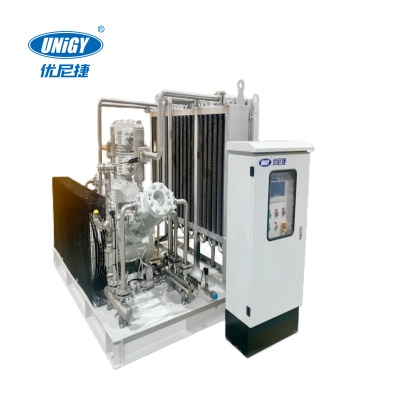
The basic workflow is as follows: ambient-pressure nitrogen from a nitrogen generator or liquid nitrogen vaporizer enters the compressor inlet; the compression chamber (e.g., cylinder, screw rotors, or impeller) performs work on the gas to increase its pressure; heat generated during compression is removed via cooling systems (air- or water-cooled); finally, the compressed gas passes through downstream treatment units (e.g., precision filters and dryers) to remove potential contaminants before delivery.
Sealing design is a critical technical aspect. Due to nitrogen’s small molecular size, leakage is a concern. Multi-stage mechanical seals or magnetic drive couplings are commonly employed—especially in oil-free models—to minimize leakage. Per ASME PTC 10 standards, high-performance nitrogen compressors should maintain leakage rates below 0.1%.
Material compatibility is another key consideration. While nitrogen is inert, high-pressure and high-temperature conditions may induce reactions with certain metals. Thus, compression chambers are typically constructed from 316L stainless steel or specialty alloys to ensure long-term reliability. Modern units also integrate PLC or DCS control systems for real-time monitoring of pressure, temperature, vibration, and remote diagnostics.
In terms of energy efficiency, GB 19153-2019 (Energy Efficiency Standards for Positive Displacement Air Compressors) stipulates that high-efficiency nitrogen compressors should achieve specific power consumption below 6.5 kW/(m³/min). Technologies such as variable frequency drives and waste heat recovery have enabled some new models to improve efficiency by over 15%.
As industrial gas demands grow more sophisticated, nitrogen compressors are evolving toward greater intelligence, modularity, and noise reduction—advancing core technologies to support stable, high-purity gas supply for advanced manufacturing.