Understanding the Structure and Operating Principle of Rotary Vane Vacuum Pumps
Rotary vane vacuum pumps are among the most widely used positive displacement vacuum systems in industrial and laboratory applications. Their reliability, consistent performance, and ability to achieve medium to high vacuum levels—typically ranging from 10⁻³ mbar to atmospheric pressure—make them indispensable across sectors such as semiconductor manufacturing, analytical instrumentation, and freeze-drying processes.
The core structure of a rotary vane vacuum pump consists of several key components: a cylindrical stator housing, an eccentrically mounted rotor, spring-loaded vanes (usually made of carbon or composite materials), inlet and exhaust ports, and an oil-sealing system in oil-lubricated models. The rotor is positioned off-center within the stator chamber, creating a crescent-shaped working space. As the rotor turns, centrifugal force pushes the vanes outward against the inner wall of the stator, forming sealed chambers between adjacent vanes.
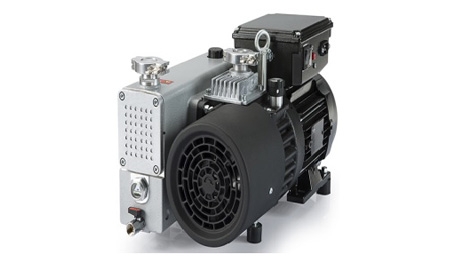
During operation, gas enters through the inlet port into the expanding chamber formed by the rotating vanes. As the rotor continues its rotation, the volume of this chamber decreases progressively, compressing the trapped gas. Once the compressed gas reaches sufficient pressure—typically just above atmospheric—it is expelled through the exhaust valve. In oil-sealed rotary vane pumps, vacuum oil serves multiple critical functions: it lubricates moving parts, seals microscopic clearances between vanes and stator walls, and assists in cooling and contaminant removal. According to data from the European Vacuum Society, properly maintained oil-sealed rotary vane pumps can achieve ultimate pressures as low as 5 × 10⁻⁴ mbar.
Dry (oil-free) variants of rotary vane vacuum pumps also exist, though they generally operate at slightly higher ultimate pressures—around 10⁻² mbar—due to the absence of oil-based sealing. These models use advanced polymer or graphite vanes and precision-machined tolerances to minimize internal leakage. However, their application scope is often limited to clean, non-corrosive environments where oil contamination must be strictly avoided.
The efficiency of a rotary vane vacuum pump is influenced by factors such as rotational speed, vane material wear resistance, and thermal management. Industrial-grade units typically operate at speeds between 1,000 and 1,800 RPM, with pumping speeds ranging from 2 to 630 m³/h depending on model size. Performance curves provided by manufacturers like Pfeiffer Vacuum and Agilent Technologies indicate that volumetric efficiency remains above 85% under standard operating conditions when maintenance intervals are observed.
Proper alignment of the rotor and uniform vane wear are essential for sustained performance. Misalignment or excessive clearance can lead to reduced compression ratios and increased backstreaming. Moreover, the choice of vacuum oil significantly impacts vapor pressure and oxidation stability; synthetic oils with low vapor pressure (<10⁻⁴ mbar at 20°C) are recommended for high-vacuum applications.
In continuous-duty scenarios, temperature control becomes critical. Excessive heat accelerates oil degradation and vane wear. Many modern rotary vane vacuum pumps incorporate integrated thermostatic bypass valves and cooling fins to maintain optimal operating temperatures below 80°C, as recommended by ISO 21360 standards for vacuum pump testing.
Given their mechanical simplicity and robust design, rotary vane vacuum pumps continue to serve as a benchmark in vacuum technology. Their adaptability across diverse operational environments underscores their enduring relevance in both research and industrial settings.