The Application Value of Oil-Free High-Pressure Air Compressors in Precision Manufacturing
In the context of the rapid development of industrial automation and intelligent manufacturing, the requirements for compressed air quality are increasingly stringent. Particularly in industries with high demands for gas purity, such as electronics, pharmaceuticals, food processing, and precision instruments, traditional lubricated air compressors can no longer meet process requirements. At this point, oil-free high-pressure air compressors have gradually become an important equipment choice for high-end manufacturing due to their oil-free pollution output and reliable operation.
The core technology of oil-free high-pressure air compressors lies in their design that completely eliminates oil lubrication from the compression process. By adopting oil-free compression methods such as water lubrication, dry screw, or scroll technology, they ensure that the discharged compressed air contains no oil, thereby avoiding contamination of subsequent processes. For example, in semiconductor wafer manufacturing, even trace amounts of oil vapor can lead to a decrease in product yield; in the pharmaceutical industry, compressed air is often used for material conveying or packaging, and any oil contamination would directly affect drug safety. Therefore, in such scenarios, oil-free high-pressure air compressors are not just a device replacement, but a key component in ensuring product quality.
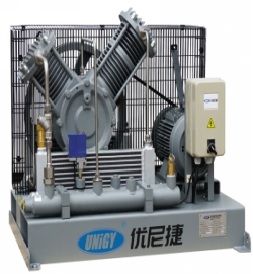
From an energy efficiency perspective, oil-free high-pressure air compressors have made significant progress in structural optimization and material upgrades in recent years. Some new models use high-efficiency permanent magnet motors and intelligent variable frequency control technology, which can automatically adjust output power under different load conditions, effectively reducing energy consumption. Meanwhile, because the oil-free design reduces the maintenance complexity associated with lubrication systems, the overall machine failure rate is relatively low, giving them a cost advantage in long-term operation. Of course, this does not mean oil-free high-pressure air compressors are suitable for all working conditions—the initial investment is usually higher than comparable lubricated models, and they have certain requirements for the cleanliness of the intake environment. Therefore, a comprehensive assessment based on the specific application scenario is necessary during the selection process.
In terms of system integration, oil-free high-pressure air compressors often require配套 equipment such as dryers, filters, and air receivers to further improve gas quality. When designing a compressed air system, professional engineers will reasonably configure the parameters of the main unit and auxiliary equipment based on the pressure fluctuation range, flow peak, and dew point requirements of the gas usage points, ensuring the entire system can supply gas stably even under high load. Furthermore, the introduction of remote monitoring and predictive maintenance functions also demonstrates the stronger adaptability of oil-free high-pressure air compressors in terms of intelligent management.
As national policies on green manufacturing and energy conservation continue to advance, the technological iteration of oil-free high-pressure air compressors will continue to accelerate. In the future, their application potential in emerging fields such as hydrogen energy, lithium batteries, and bioengineering is worth anticipating. For equipment purchasers, selecting a supplier with mature technical expertise and localized service capabilities will help fully leverage the performance advantages of oil-free high-pressure air compressors, achieving a dual improvement in production efficiency and product quality.