Key Points for Selection and Operation & Maintenance of Oil-Free High-Pressure Air Compressor Systems
In industrial gas power systems, oil-free high-pressure air compressors are widely used in production processes that are sensitive to air quality due to their clean and reliable gas supply characteristics. However, to fully leverage their performance advantages, it relies not only on the manufacturing quality of the equipment itself but also on a scientific and reasonable selection strategy and standardized operation and maintenance procedures.
First, during the selection phase of an oil-free high-pressure air compressor, the specific needs of the application scenario must be clearly defined. This includes, but is not limited to: the required discharge pressure (usually above 10 bar), continuous or intermittent gas usage patterns, daily average gas consumption fluctuations, and restrictions on dew point temperature and particulate matter content. For example, in optical fiber drawing processes, the compressed air needs to maintain constant high pressure and be absolutely oil-free, so dry screw or centrifugal oil-free high-pressure air compressors should be prioritized. In laboratory analytical instrument gas supply scenarios, although the gas consumption is small, the requirements for gas purity are extremely high, so a small scroll-type oil-free model can be selected.
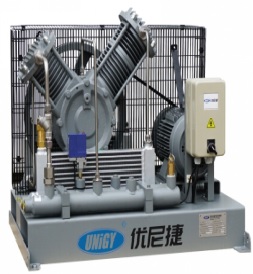
Second, the installation environment is crucial for the long-term stable operation of oil-free high-pressure air compressors. Due to the lack of cooling and sealing effects provided by lubricating oil, the internal moving parts of oil-free models are more sensitive to temperature and dust. Therefore, it is recommended to install the equipment in a machine room with good ventilation, controlled temperature and humidity, and far away from dust sources. Meanwhile, a high-efficiency air filter should be installed at the air inlet and replaced regularly to prevent impurities from entering the compression chamber and causing wear.
During daily operation, although oil-free high-pressure air compressors eliminate the maintenance work associated with oil circuits, attention still needs to be paid to the status of other key components. This includes whether the cooling system is unobstructed, whether the electrical control system responds normally, and whether the safety valve and pressure sensor are accurately calibrated. It is recommended to establish a complete equipment operation log to record parameters such as start/stop times, loading times, and discharge temperature, which facilitates trend analysis and preventive maintenance in the later stages.
It is worth noting that the energy consumption performance of oil-free high-pressure air compressors is closely related to their load matching. If the system operates under low load for a long time, it will not only cause energy waste but may also affect the equipment's lifespan. Therefore, in situations with multiple parallel units, a central control system can be introduced to dynamically start and stop units based on actual gas demand, achieving optimal energy efficiency.
With the deepening of the Industry 4.0 concept, more and more oil-free high-pressure air compressors are beginning to integrate IoT modules that support remote data collection and fault warnings. This trend provides equipment managers with more efficient maintenance methods and also sets higher requirements for the digital capabilities of technical personnel. In future factory construction, oil-free high-pressure air compressors will not only be a power source but also an indispensable data node in the intelligent production line.